

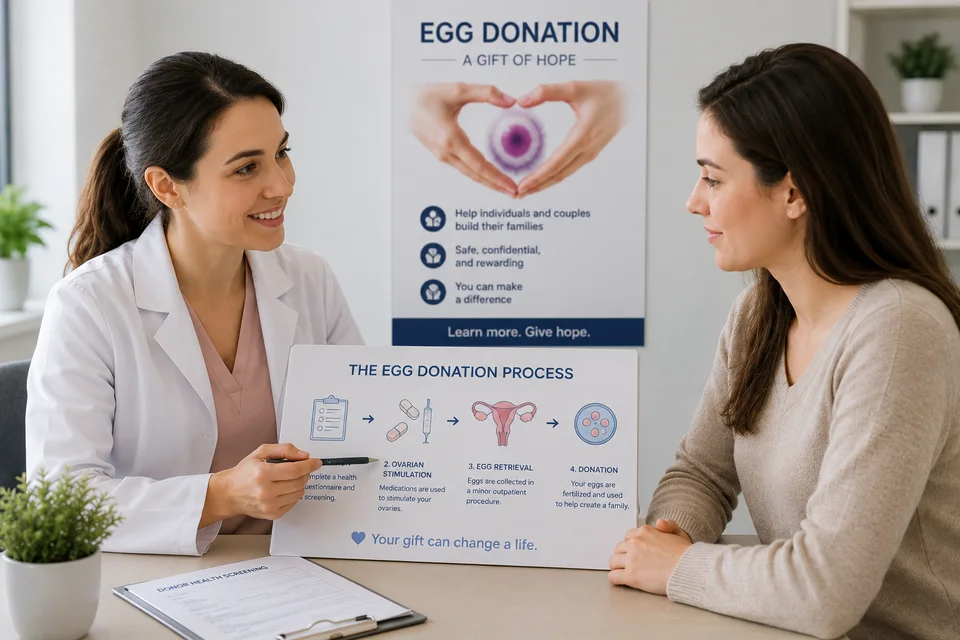
Why most surrogacy journeys need an egg donor
Egg donors in surrogacy are not a niche option. They are a structural part of how parenthood happens for a large share of the families we work with. The reasons are personal, and the solution is more accessible than most people realize.
The most common reason is also the most hopeful one: biology, not desire, is the limit
The need for an egg donor usually has nothing to do with how much someone wants to be a parent. It is a medical reality that opens a different path — and that path works, beautifully, when it is run with care.
Same-Sex Male Couples
Single Men
Medical Indication
Genetic Reasons
Using an egg donor does not make the resulting child “less yours.” It makes the journey possible. In gestational surrogacy, the intended parents are listed on the birth certificate from day one — the donor has no parental role.
- Donor has no parental rights or obligations in any of our destinations.
- Intended parents are the legal progenitors from the start.
- The donor’s contribution is medical, not legal or relational.
- The match is anonymous or identity-release, depending on the program.

How to choose an egg donor (criteria and process)
Every donor is unique, but they share the qualities that matter most: youth, health, emotional maturity, and a sincere motivation to help. These are the profiles we see most often in our curated donor pool.
The Young Healthy Donor
Usually 21–28
No hereditary history
Empathy & solidarity
The Repeat Donor
Usually 24–32
Proven response
Confirmed commitment
The Family-Connected Donor
Usually 25–34
Clean & stable
Lived experience
Finding the right egg donor for your family
Matching a donor to your family is a careful, two-way conversation. The medical team proposes candidates. You make the final call. And the program only moves forward when you feel genuinely comfortable with the choice.
A Donor Match You Can Feel Good About
Profile Review
Curated Donor List
Your Selection
Stimulation & Retrieval
Egg donor screening: medical, genetic, psychological
The legal and medical requirements for egg donors exist to protect three things: the donor’s health, the quality of the eggs, and the wellbeing of the child who will be born.

How we screen our egg donors?
Every candidate must pass three independent layers of evaluation before being introduced to intended parents. Most applicants do not make it through all three — and that is by design.
The screening covers medical and genetic history, psychological readiness, and hormonal and fertility assessment. Only when all three check out do we move forward with a match.
Legal Age & Capacity
Good Overall Health
Normal Ovarian Function
Pre-Donation Medical Exams
Informed, Voluntary Consent
Three categories of tests we run on every donor
The medical screening is the heart of the egg donor program. Every donor, without exception, goes through the same three layers of evaluation. Nothing is skipped, and the results are reviewed by a multidisciplinary team before any match is proposed.
Physical & Gynecological Exam
- Full review of personal and family medical history
- Complete physical examination
- Detailed gynecological evaluation
- Pelvic ultrasound to assess ovarian reserve
- Baseline vital signs and body mass index
Comprehensive Blood Tests
- HIV, hepatitis B, hepatitis C, and syphilis screening
- FSH, LH, and estradiol hormone levels
- AMH (anti-Müllerian hormone) for ovarian reserve
- Complete blood count and metabolic panel
- Additional serology as required by the clinic
Genetic & Psychological Tests
- Karyotype to detect chromosomal abnormalities
- Carrier screening for common hereditary conditions
- Targeted genetic panels when relevant
- Psychological evaluation with a licensed professional
- Confirmation of informed, voluntary consent
Egg Donors in Surrogacy: Frequently Asked Questions
The questions intended parents ask us most often about the egg donors in our program. If you do not see your question here, send us a message and we will answer personally.
Why do most surrogacy journeys need an egg donor?
Many intended parents — including same-sex male couples, single men, women with no viable eggs, women with genetic conditions they do not want to pass on, or women of advanced maternal age — need an egg donor to create the embryo that the surrogate will carry. Egg donation is what makes parenthood possible in these cases.
What are the legal requirements to become an egg donor?
Egg donors must be at least 18 years old, typically no older than 35, and have the legal capacity to give informed consent. They must also be in good physical and mental health, with normal ovarian function, and have no history of hereditary or transmissible genetic conditions.
What medical tests are run on every egg donor?
Every donor undergoes three categories of tests: a general and gynecological physical exam (including ultrasound for ovarian reserve), comprehensive blood tests (HIV, hepatitis B and C, syphilis, FSH, LH, estradiol, AMH), and genetic tests (karyotype and common hereditary conditions), plus a psychological evaluation.
Can I choose the egg donor for my baby?
Yes. After the initial screening, you receive curated donor profiles with relevant medical, personal, and physical background. You choose the donor you feel most comfortable with, and the program moves forward with that match.
Is the egg donor's identity anonymous?
It depends on the destination country and the type of program. In most international programs, donors are anonymous by default but you receive extensive non-identifying information. In some destinations, identity-release donations are also possible.
How long does the egg donation process take?
From donor selection to embryo creation, the process typically takes 4 to 8 weeks, depending on the donor’s cycle, the clinic’s schedule, and whether fresh or frozen eggs are used. We will give you a precise timeline based on your specific case.
Will my baby look like me if we use an egg donor?
When intended mothers provide the egg, the child carries her genetic material. When using a donor, the child carries the donor’s genetics. Many intended parents choose donors whose physical background feels meaningful to them — and we guide you through that decision with full transparency about what to expect.